

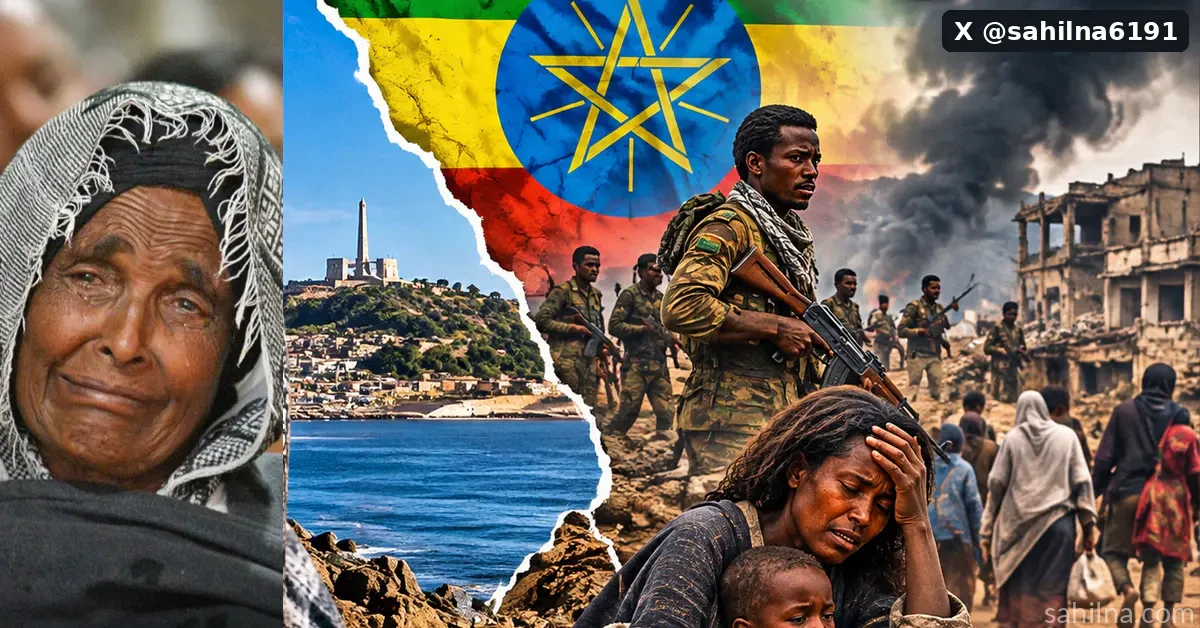
Internal Repression, Political Ambitions and the Threat to Sovereignty in the Horn of Africa
Ethiopia is confronting a deepening political, security and institutional crisis. Yet the implications of this crisis extend far beyond its national borders. What is unfolding inside Ethiopia increasingly raises fundamental questions about regional stability, respect for sovereignty and the future of the Horn of Africa.
From Tigray to Amhara and Oromia, the civilian population continues to bear the consequences of prolonged armed conflict, political fragmentation and deteriorating security conditions. Reports of killings, extrajudicial executions, arbitrary arrests, forced displacement and abuses involving state security forces demand serious international scrutiny.
For millions of Ethiopians, insecurity has become an everyday reality.
The government in 4 Kilo cannot continue to present itself as an agent of national transformation while failing to address the profound human and political consequences of its own governance.
State authority carries obligations. Protecting civilian lives, upholding constitutional rights and ensuring accountability are not optional responsibilities. They are fundamental requirements of legitimate governance.
Allegations of unlawful killings and abuses involving government security forces must be independently investigated. Equally, crimes committed by armed non-state actors must be addressed without political selectivity.
No government, armed movement or political organisation should be permitted to place itself above the law.
The people of Ethiopia must not remain hostages to an endless cycle of political confrontation and armed violence.
The politics of appearances: a growing disconnect
While the country struggles with multiple internal conflicts, Prime Minister Abiy Ahmed continues to devote considerable attention to international appearances, promotional campaigns, grand development announcements and the projection of national prestige.
The contradiction is increasingly difficult to overlook.
A government cannot credibly proclaim national transformation while communities remain exposed to violence, displacement and insecurity.
Infrastructure projects, economic ambitions and international visibility may contribute to development, but they cannot replace political accountability, public security or institutional legitimacy.
National progress is not measured by carefully produced videos, diplomatic photographs or the number of projects inaugurated. It is measured by whether citizens can live safely, whether institutions function independently and whether the government is accountable to the population.
The political leadership in Addis Ababa must confront a fundamental reality: no communication strategy can indefinitely conceal a crisis of governance.
The credibility of a government is established through its treatment of its people, not through the image it constructs for international consumption.
Eritrea’s sovereignty is not a negotiable geopolitical asset
One of the most consequential developments in the current regional environment is the increasingly confrontational discourse surrounding Ethiopia’s access to the Red Sea.
Ethiopia’s landlocked status is a geographical and economic reality. Its interest in reliable maritime access is understandable. However, legitimate economic interests do not create sovereign entitlements over the territory, coastline or ports of another independent state.
There is a fundamental distinction between access through negotiated arrangements and the pursuit of sovereign control over territory belonging to a neighbouring country.
International law recognises the sovereignty and territorial integrity of states. These principles cannot be selectively respected or reinterpreted according to the strategic ambitions of a larger neighbour.
Eritrea is an independent, sovereign state. Its borders, territorial integrity and national independence are not subjects for unilateral revision.
No country’s geographical circumstances grant it the right to challenge another country’s sovereignty.
The Red Sea must not become an arena for territorial expansion, military coercion or geopolitical entitlement. Its security requires cooperation among the states concerned, respect for international law and recognition of the legitimate interests of coastal nations.
Any attempt to transform maritime access into a question of territorial possession would undermine the foundations of peaceful coexistence in the region.
Eritrea’s sovereignty is not a bargaining instrument. Nor should the independence of any African state be treated as negotiable.
The horn of africa must not become a theatre of expansionism
The internal crisis in Ethiopia is increasingly intertwined with wider regional tensions.
The fragile relationship between Ethiopia and Eritrea, the continuing conflict in Sudan, instability in Somalia and competing strategic interests around the Red Sea create an exceptionally sensitive geopolitical environment.
A military confrontation between Ethiopia and Eritrea would carry consequences far beyond the two countries. It could disrupt regional trade, undermine maritime security, deepen existing rivalries and expose neighbouring populations to another devastating cycle of conflict.
The international community and African institutions must therefore take seriously the dangers of escalating rhetoric, military mobilisation and unresolved territorial questions.
The African Union was founded on principles that include the sovereign equality of states, territorial integrity and the peaceful resolution of disputes.
These principles must apply consistently.
Africa cannot advance towards genuine independence while territorial ambitions, political coercion and the unequal treatment of neighbouring states remain acceptable instruments of statecraft.
African sovereignty cannot be defended selectively. The independence of a small state is no less sacred than that of a large one.
The Horn of Africa does not need another struggle over territory or access to strategic waterways. It needs responsible leadership, diplomatic restraint and a regional order based on mutual respect.
Africa needs responsible governance, not political hegemony
The fundamental problem confronting the region is not simply Ethiopia’s internal instability. It is the danger that unresolved domestic political failures may increasingly shape its external conduct.
A country struggling with internal fragmentation cannot afford to substitute regional confrontation for domestic political solutions.
The political establishment in 4 Kilo must recognise that national prestige cannot be built at the expense of neighbouring states. Nor can domestic legitimacy be secured through external confrontation.
The future of Ethiopia ultimately depends on its ability to address internal divisions, protect its citizens, establish accountable institutions and develop relations with neighbouring countries on the basis of equality and mutual respect.
This is not an argument against the Ethiopian people. On the contrary, they deserve peace, security and a political future free from permanent conflict.
The suffering of Tigrayans, Amharas, Oromos and other communities must never be diminished or manipulated for political purposes. Their lives and dignity matter equally.
The same principles of sovereignty and human dignity must guide relations between African states.
The final question: what kind of africa are we building?
Africa’s independence was not achieved so that one sovereign state could question the territorial integrity of another.
It was achieved through struggles against domination, colonial rule and the denial of national self-determination.
Those principles cannot lose their meaning when political interests change.
Eritrea’s independence and sovereignty deserve the same respect afforded to every other African nation. Ethiopia’s people deserve responsible government and an end to the violence that continues to undermine their future.
These positions are not contradictory. They are inseparable principles of a stable and independent Africa.
The government in 4 Kilo must be judged by its domestic record, its respect for international law and its conduct towards neighbouring states.
A nation’s ambitions do not supersede the sovereignty of another nation. Geography does not confer ownership. Political power does not grant territorial entitlement.
The Horn of Africa deserves peace, not another war. Africa deserves sovereign equality, not regional domination.
And Eritrea’s independence is not open for negotiation.
Sovereignty is not a political favour. It is a fundamental principle of African independence.