

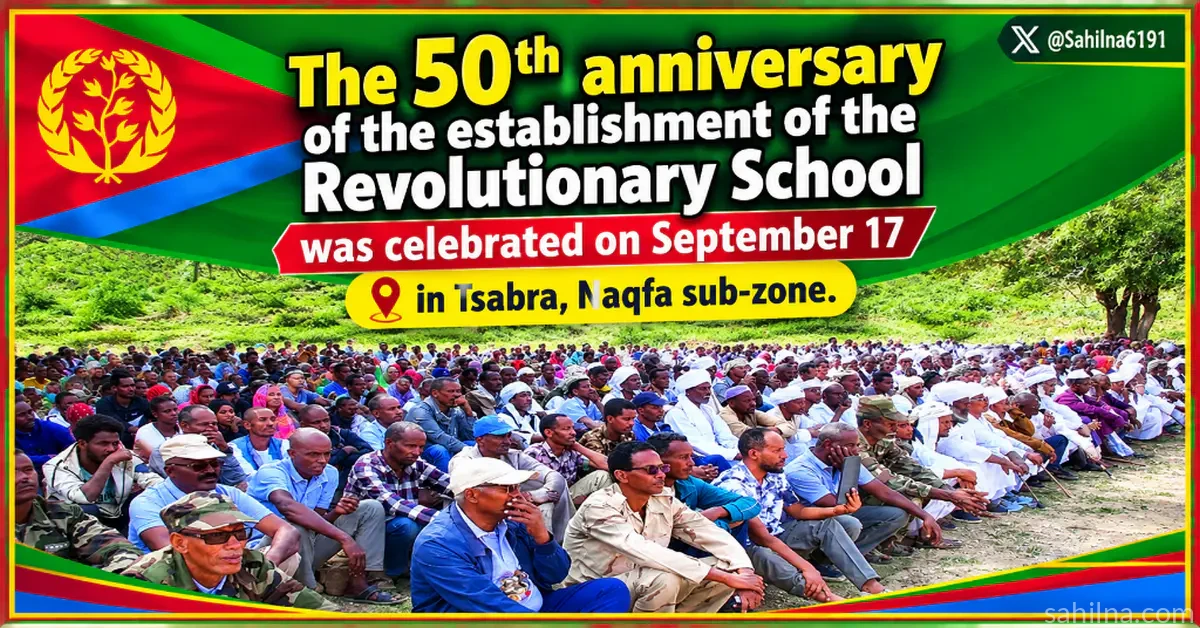
The 50th anniversary of the establishment of the Revolutionary School was commemorated on September 17 in Tsabra, in the Naqfa sub-zone. More than a commemorative occasion, the anniversary offered an opportunity to return to a formative chapter in Eritrea’s modern history and to reflect on the meaning of education under extraordinarily difficult circumstances.
Fifty years is long enough for a generation to become history. Yet the memories associated with the Revolutionary School remain closely connected to the people who experienced them. For many, the school was not simply a place where lessons were taught. It represented an effort to preserve learning, discipline, community, and human development under conditions in which ordinary educational structures could not be taken for granted.
The story of the Revolutionary School belongs to a period when education was deeply connected to the broader social and historical circumstances of Eritrea. Learning did not exist separately from the realities surrounding the people. Children and young people were growing up in an environment shaped by displacement, insecurity, limited resources, and political upheaval. In that setting, establishing and maintaining a school required more than classrooms and books. It required organisation, sacrifice, and a belief that education could not be postponed indefinitely.
That is one of the reasons why returning to the history of the Revolutionary School matters.
Education Under Difficult Circumstances
The significance of the school cannot be understood only through the number of students who passed through it or the subjects that were taught. Its deeper importance lies in the circumstances in which education was pursued.
In many societies, education is associated with stability: permanent buildings, trained teachers, established curricula, libraries, and predictable academic calendars. The Revolutionary School emerged from a very different reality. Education had to develop alongside a movement and a population confronting circumstances that repeatedly disrupted ordinary life.
Teachers therefore carried responsibilities extending beyond academic instruction. Students were exposed to an environment in which education, community responsibility, and the realities of their society were closely intertwined.
The experience also created a particular relationship between teacher and student. Resources could be limited, but education continued. The physical surroundings could be difficult, but learning remained a priority.
That persistence is an important part of the historical record.
Tsabra and the Memory of a Generation
The anniversary gathering in Tsabra brought together people from different generations, including those whose lives were directly connected to the history being remembered.
The landscape itself provides an important contrast to the passage of time. Fifty years can transform institutions, technologies, and societies, while the places in which important events occurred can retain a remarkable sense of continuity.
For those who attended the anniversary, returning to such a place was therefore not simply a visit to the past. It was a meeting between generations.
Older participants carry memories that cannot be reconstructed from documents alone: the conditions in which students studied, the responsibilities they carried, the relationships formed between classmates and teachers, and the everyday realities that surrounded education.
Younger generations encounter that history differently. For them, the Revolutionary School is increasingly something to be understood through the memories of parents, relatives, teachers, and former students.
This makes remembrance particularly important.
History does not survive only in archives. It also survives through people.
The Meaning of a School Beyond Its Classrooms
A school can be measured by buildings, enrolment figures, and academic results. But institutions created during periods of profound social change often acquire a wider significance.
The Revolutionary School became part of an effort to ensure that an entire generation would not be deprived of education because of the circumstances into which it was born.
That distinction is important.
Education in such an environment was not merely preparation for an individual career. It was also a means through which knowledge, cultural memory, and a sense of responsibility could be transmitted from one generation to another.
The school therefore belongs to a larger history of Eritrean education: a history in which learning repeatedly had to adapt to changing circumstances while remaining connected to the needs of society.
Fifty Years Later
Half a century after its establishment, the anniversary invites a different kind of reflection.
The students of the early years are now parents, grandparents, professionals, community members, and custodians of memories that increasingly belong to another era. Their personal experiences provide an important bridge between the history of the 1970s and the Eritrea of today.
Their stories also raise questions for the present generation.
What does it mean to inherit an educational institution shaped by such difficult circumstances?
What lessons can be carried forward without reducing history to nostalgia?
And how can the experiences of those who built and attended the school be preserved for people who did not live through that period?
These questions become particularly relevant as time moves further away from the original generation.
Preserving the Roots
The 50th anniversary in Tsabra is therefore more than a date on a commemorative calendar. It is an opportunity to document a part of Eritrea’s educational and social history while many of its direct witnesses are still able to tell their stories.
Photographs, personal testimonies, school records, and the memories of former students and teachers can provide future generations with a more complete understanding of what the Revolutionary School represented and the circumstances surrounding its development.
The value of such history lies not in turning the past into mythology, but in preserving its complexity.
The Revolutionary School emerged from a particular time, among particular people, under particular circumstances. Its history contains hardship as well as determination, limitations as well as achievement, and personal memories alongside broader historical developments.
Fifty years later, returning to Tsabra means returning to those roots.
It is a reminder that institutions are ultimately built by people — and that the history of education is also the history of generations who refused to allow difficult circumstances to determine the limits of what their children could learn, become, and contribute.
This Revolutionary School Was and is one of the remarkable victories of EPLF within the challenging time in our history. Our students should know how and in which condition their fathers (that day’s revolutionary students) passes through, and should follow this truck of strength, which cannot be found anywhere except in Eritrea, on which we are very…very proud of.
Thank you for your valuable and moving comment. ❤️🇪🇷
We, as the Sahilna team, are ourselves the children of the revolutionary students of that remarkable school. We are proud to come from this history and to carry the legacy of our fathers and mothers within us. Their sacrifices, strength, and unwavering commitment will never be forgotten.
It is our responsibility to pass these values on to the next generation and to honor this remarkable history.
Proud of our roots, proud of our history, and proud to be part of this legacy! 🇪🇷❤️✊
Sahilna Team.