

Prime Minister Abiy Ahmed presents himself to the world as a reformer, a modern statesman, and a champion of African unity. Yet behind the carefully staged diplomacy lies a harsher reality: Ethiopia’s regime increasingly governs through propaganda, intimidation, militarization, and geopolitical pressure.
Western diplomats continue to speak of “partnership” and “regional stability,” but Ethiopia under Abiy is sinking deeper into political crisis, economic decline, and internal fragmentation. Millions of Ethiopians face inflation, insecurity, armed conflict, and state repression. International monitors have documented mass arrests, extrajudicial killings, restrictions on press freedom, drone strikes on civilians, and widespread abuses carried out under state authority.
Instead of resolving Ethiopia’s internal crises, the regime has turned outward deploying nationalist rhetoric and external tensions as political distraction.
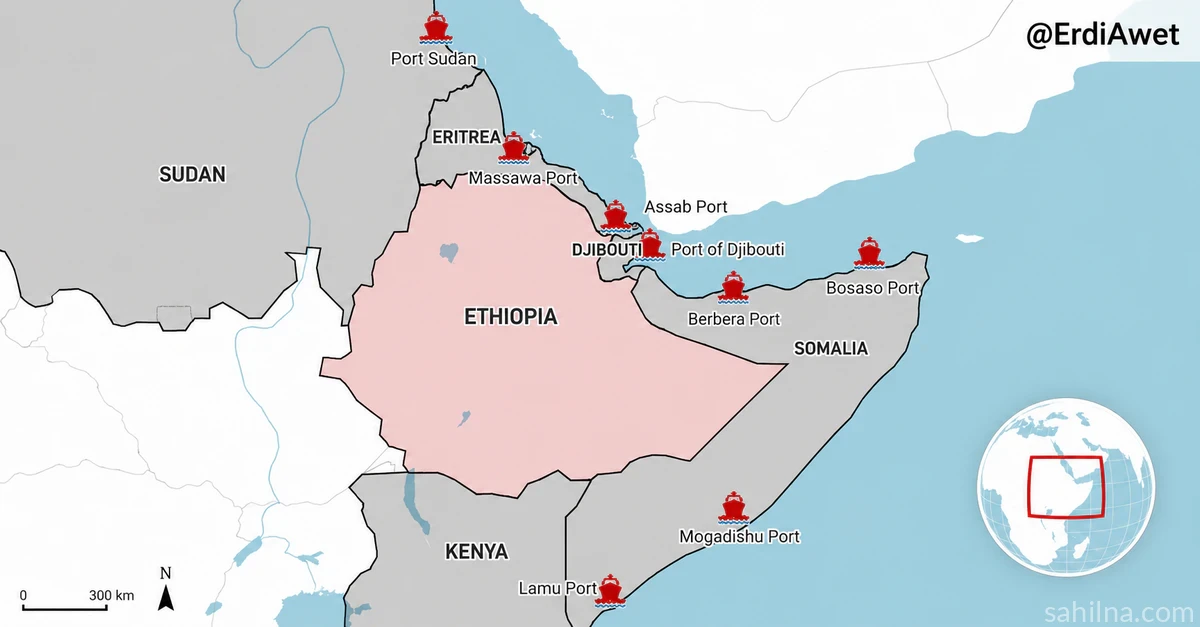
Nothing illustrates this more clearly than the dangerous discourse surrounding the Red Sea.
In speeches delivered in Amharic, Abiy Ahmed and senior military officials have repeatedly declared that Ethiopia will secure “sovereign access” to the sea “peacefully if possible, militarily if necessary.” State narratives increasingly portray Eritrea’s coastline, and those of neighboring states, as negotiable assets justified by Ethiopia’s alleged “historical rights” or “strategic necessity.”
This is not diplomacy. It is war provocation.
The facts remain clear: no country in the region has denied Ethiopia commercial access to ports. Eritrea has never opposed economic cooperation, trade agreements, or regional connectivity based on mutual consent and sovereign equality. What Eritrea rejects is the arrogant assumption that a larger state can pressure smaller neighbors into compromising their sovereignty.
Eritrea paid an enormous price for independence. Tens of thousands of Eritreans died during the long struggle against occupation and foreign domination. That sacrifice is not symbolic it is foundational to Eritrean national identity. For this reason, Eritrea will never accept renewed fantasies from politicians in Addis Ababa who speak as though Eritrean territory or coastline can be treated as bargaining chips.
Excerpt
The real crisis facing Ethiopia is not access to the sea.
The real crisis lies within Ethiopia itself: ethnic tensions, armed insurgencies, economic collapse, political fragmentation, and declining public trust. Nationalist mobilization has become a substitute for genuine political solutions.
The Horn of Africa is already one of the world’s most fragile regions. Sudan is collapsing under civil war, foreign powers compete for influence along the Red Sea, and millions suffer displacement, famine, and insecurity. In such an environment, openly discussing militarily enforced access to the sea is not only irresponsible it is profoundly destabilizing.
Eritrea, by contrast, has consistently upheld a clear position: respect for sovereignty, non‑interference, regional cooperation based on equality, and rejection of hegemonic politics. This is precisely why Addis Ababa’s rhetoric is generating growing concern across the region. Increasingly, regional actors recognize that the issue is not economics or trade access it is power projection, political pressure, and the normalization of expansionist thinking.
Diplomatic theater must no longer obscure reality. A government cannot speak of peace abroad while normalizing military threats at home. It cannot present itself as a force for stability while promoting rhetoric that risks igniting confrontation.
The Nobel Peace Prize once symbolized hope. Today, it stands as a painful irony.
The defining legacy of Abiy Ahmed’s era is no longer reconciliation or reform. It is polarization. Militarization. Internal collapse. Regional tension. And the growing fear that Ethiopia’s leadership is steering the Horn of Africa toward unnecessary confrontation.
Eritrea has every right to defend its sovereignty, its coastline, and its national dignity against intimidation or territorial ambition. The Horn of Africa cannot afford another reckless gamble with peace.
The choice before Ethiopia’s leadership is stark: resolve internal crises through genuine reform, or continue down a path of militarized distraction that threatens not only Eritrea’s sovereignty but the stability of the entire region.