

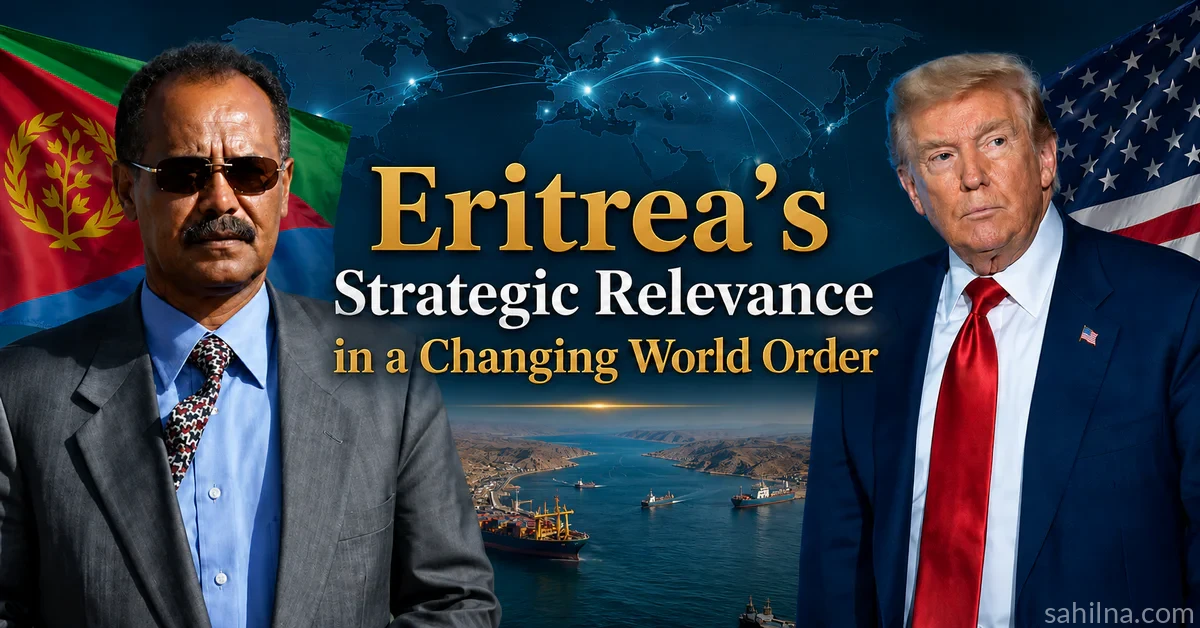
Excerpt
“Sanctions against Eritrea were justified for years on security allegations. Yet fundamental questions remain unresolved: Where is the conclusive evidence?”
Until recently, Eritrea was widely portrayed in international discourse as an isolated, sanctioned state under heavy political pressure. In much of the Western media narrative, it was framed as an outlier — a difficult actor, a geopolitical problem at the Horn of Africa.
Today, however, that tone is shifting. Even the United States appears to be reassessing its stance toward Eritrea. Reports of potential diplomatic re-engagement and discussions surrounding the easing of remaining sanctions suggest a clear shift in geopolitical reality. With this, Eritrea’s strategic relevance is being redefined.
International politics is undergoing structural transformation. The era of uncontested Western dominance is gradually eroding. New centers of power are emerging, global trade routes are increasingly contested, and strategic regions such as the Red Sea are regaining critical importance.
What has often been underestimated is Eritrea’s long-term strategic view. While many states adapted their policies to external pressure or short-term interests, Eritrea maintained a consistent focus on sovereignty, independence, and strategic autonomy. This approach brought sanctions, isolation, and sustained criticism but it also preserved Eritrea’s political orbit. That persistence is now reshaping how the country is perceived internationally.
For years, sanctions against Eritrea were justified on the basis of security allegations and regional instability. Yet fundamental questions remain unresolved.
Where is the conclusive evidence? Why was there never a fully transparent international investigation? Why were severe political measures maintained for so long despite growing doubts about the original claims?
Across Africa, Eritrea has come to symbolize more than just a state. It represents an attempt by an African nation to define its own path independently of global power blocs. This is not about opposition to the West. Eritrea is not calling for confrontation. It is calling for respect for its policy of self-reliance.
Among younger generations across the continent, there is growing awareness of how sanctions, narratives, and economic pressure have often been deployed against states that pursue independent political paths. Within this context, Eritrea has gained symbolic significance. Its principled self-reliance policy has allowed it to maintain sovereignty under the shadow of Western political and economic pressure.
The Horn of Africa is one of the most strategically significant regions in the world. The United States, China, Russia, Gulf states, and other global actors are competing for influence, access, and positioning in the Red Sea corridor.
In this new geopolitical landscape, Eritrea can no longer be ignored. Its geographic location and sustained political stance place it firmly within the regional playbook being shaped by both Western and Global South powers.
Reports of possible normalization between Eritrea and the United States reflect a broader shift, international politics is adapting to new realities. Eritrea’s strategic self-reliance policy stands as a lesson in resilience a refusal to collapse under external pressure.
Eritrea is not seeking special treatment. It is seeking equal treatment and respect for its political stance.
In the emerging world order, Eritrea will remain in its own political orbit whether the international system chooses to engage with its self-reliance policy or continue relying on pressure and exclusion.
One fact is already clear, Eritrea can be sanctioned. But it can no longer be ignored.
By Dr. Nurit Ali
Dr. Nurit Ali is interest in justice and politics