

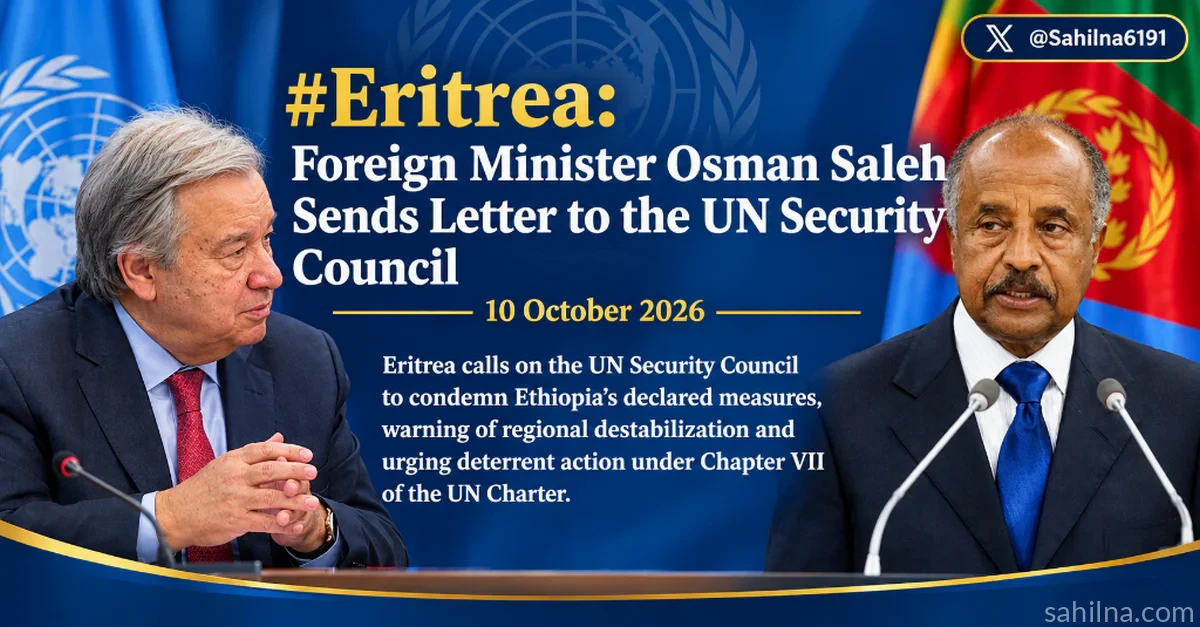
The Eritrean government has accused Ethiopia of pursuing military aggression and threatening its territorial integrity. In a communication to the United Nations Security Council, Asmara is calling for a strong condemnation of Ethiopia’s alleged war plans and appropriate deterrent measures.
Asmara, October 10, 2026 — Tensions between Eritrea and Ethiopia appear to be escalating further, following serious allegations by the Eritrean government against its neighboring country. Eritrea has called on the United Nations Security Council to take action against what it describes as Ethiopia’s declared intentions to wage war against Eritrea.
According to the Eritrean government, communications submitted by Ethiopia’s Ministry of Foreign Affairs to the UN Security Council on October 9, 2026, indicated that Ethiopia was taking measures to implement its stated military objectives.
Asmara has rejected Ethiopia’s reported attempts to justify its actions on grounds of self-defense, describing such arguments as unfounded and an attempt to legitimize potential military aggression against a sovereign UN member state.
Eritrea Warns of Threats to Its Sovereignty
The Eritrean government maintains that it has repeatedly alerted the international community to what it describes as Ethiopia’s efforts to secure sovereign access to the sea by threatening Eritrea’s sovereignty and territorial integrity.
According to Asmara, Ethiopia’s alleged threats and military plans violate fundamental principles of the United Nations Charter, particularly those concerning respect for national sovereignty, territorial integrity, and the prohibition of the threat or use of force against another state.
Eritrea argues that its independence and internationally recognized borders must be respected and that any attempt to alter them through military force would represent a serious threat to regional peace and security.
Eritrea Cites International Warnings
The Eritrean government has also referred to statements issued by the UN Secretary-General and several UN member states in December 2025, marking the 25th anniversary of the Algiers Agreement.
According to Asmara, those statements emphasized the importance of respecting Eritrea’s sovereignty and territorial integrity amid growing regional tensions.
Eritrea alleges that Ethiopia failed to heed these warnings and instead continued pursuing what Asmara characterizes as long-standing military plans against Eritrea, allegedly linking them to military operations in northern Ethiopia.
These allegations have not been independently verified in this report.
Alleged Statement by Ethiopian Military Official Raises Concern
Particular attention has been drawn to remarks allegedly made on September 27, 2026, by General Abebaw Tadesse, Ethiopia’s Deputy Chief of Staff.
According to the Eritrean government’s account, the general stated that the ultimate objective of the war was to invade Assab, while Mekelle, the capital of the Tigray administrative region, was merely a stopover on the way to an invasion of Eritrea.
Asmara views the alleged statement as evidence of possible military intentions against Eritrean territory. However, the quotation and its context require independent verification before they can be treated as established fact.
The port city of Assab, located on Eritrea’s Red Sea coast, is strategically significant to regional trade and maritime access. Any military confrontation involving the area could have serious implications for security and stability across the Horn of Africa.
Eritrea Demands Action from the UN Security Council
The Eritrean government has urged the UN Security Council to strongly condemn what it describes as Ethiopia’s declaration of war and to adopt appropriate deterrent measures.
Asmara warns that a further escalation could cause extensive destruction and suffering among the populations of both countries while destabilizing the wider region.
A separate summary accompanying the Eritrean communication states that the government has lodged a complaint with the United Nations and demanded an end to what it considers provocations and territorial violations. The precise legal basis and wording of that complaint should be confirmed against the original submission.
Regional Stability at Risk
The latest allegations underscore the fragile relationship between Eritrea and Ethiopia, two neighboring countries whose political and security relations have been marked by conflict and persistent tensions.
A renewed military confrontation could have far-reaching humanitarian, economic, and geopolitical consequences, potentially affecting neighboring countries and further complicating security across the Horn of Africa and the Red Sea region.
The response of the UN Security Council remains to be seen. Independent verification of Eritrea’s allegations, together with an official response from the Ethiopian government, would be essential to establishing a comprehensive picture of the situation.
Editorial note: This article presents the position of the Eritrean government. The allegations and the quotation attributed to the Ethiopian military official have not been independently verified for this report. The original diplomatic communications and relevant official statements should be consulted before publication.