

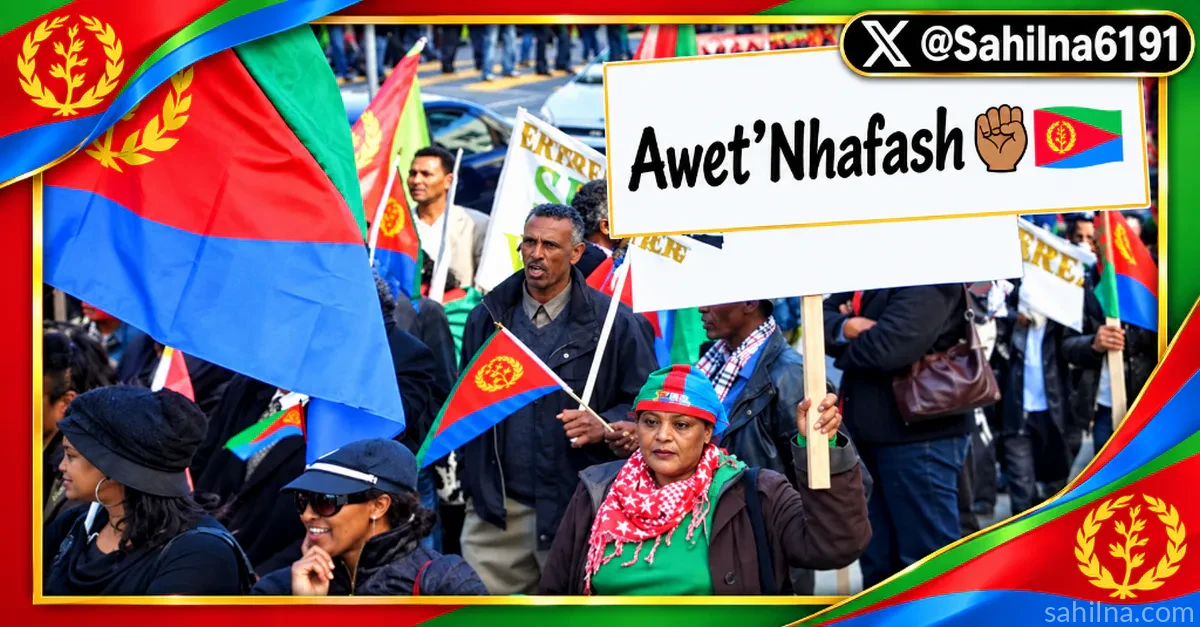
There are moments in history that appear to be about a single decision, a single government announcement, or a single change in policy. But for Eritrea, history has rarely been that simple.
The United States has removed sanctions imposed on the Eritrean Defense Forces and other Eritrean entities, according to a September 18 notice from the U.S. Department of the Treasury reported by Reuters. The sanctions were originally imposed in 2021 during the conflict in northern Ethiopia. Reuters reports that Eritrea’s Information Minister Yemane Gebremeskel welcomed the removal, describing the earlier measures as unwarranted and damaging to Eritrea.
For Eritreans, however, the significance of this moment reaches beyond the lifting of a designation.
It touches something much older: the experience of a people who have spent generations learning to endure pressure without surrendering their sense of national sovereignty.
Eritrea’s resilience was not created by sanctions, and it will not disappear with their removal.
It was formed long before today’s diplomatic language.
It was formed through a history in which Eritreans repeatedly confronted circumstances in which the existence, independence and political choices of the country were contested by forces far more powerful than Eritrea itself.
That history helps explain why Eritrean society has often viewed external pressure through a different lens from the one used in foreign capitals.
For many Eritreans, sanctions were never simply an entry on a government list. They were experienced within a much broader historical memory — a memory shaped by colonial rule, federation, annexation, armed struggle, independence and the continuing effort to protect sovereignty in one of the world’s most strategically contested regions.
The sanctions imposed in 2021 were connected by Washington to Eritrean actors and the war in northern Ethiopia. The U.S. Treasury at the time stated that the measures targeted the Eritrean Defense Force, the People’s Front for Democracy and Justice and other Eritrean entities and individuals under Executive Order 14046.
Five years later, the political circumstances have changed.
The sanctions have been removed.
But the deeper question is what this change tells us about Eritrea’s place in the region.
Eritrea sits on one of the most consequential maritime corridors in the world. Its coastline stretches along the Red Sea, facing one of the world’s most strategically important waterways. Reuters noted that the renewed attention to the Red Sea and the region’s changing security environment has increased the strategic significance of Eritrea’s location.
This is where Eritrea’s history and geography meet.
A country does not choose its geography.
Eritrea did not choose to stand beside the Red Sea, next to the Bab el-Mandeb, at the meeting point of Africa and the Middle East. But generations of Eritreans have understood that geography brings both opportunity and vulnerability.
The Red Sea has always been more than water surrounding the country.
It has been a corridor of civilizations, commerce, military competition and political influence.
And Eritrea has remained there through all of it.
That continuity matters.
The removal of sanctions does not erase the disputes and competing interpretations surrounding the wars of the region. Nor does one policy decision rewrite the historical record. But it does demonstrate something important about international politics: policies change as circumstances change, and relationships that once deteriorated can also move in another direction.
For Eritreans, this is precisely why national resilience has mattered.
Resilience is not the absence of hardship.
It is the ability to remain standing while hardship changes form.
At different moments, Eritrea has faced military pressure, diplomatic isolation, economic restrictions and international campaigns of criticism. The country’s response has repeatedly been shaped by the conviction that its national interests cannot simply be outsourced to external powers.
That conviction has deep roots.
The independence struggle itself was built around an insistence that Eritreans should determine Eritrea’s future.
That principle did not begin with independence in 1993.
It was forged through decades of struggle.
It survived war.
It survived displacement.
It survived political isolation.
And it survived the difficult years that followed independence.
This is why the removal of sanctions should not be understood simply as a victory over another country, nor as the end of every disagreement between Eritrea and the outside world.
It is better understood as another chapter in a much longer story.
A story in which Eritrea has repeatedly been forced to navigate an international environment where powerful states pursue their own strategic interests, regional alliances shift, and yesterday’s assumptions can become today’s liabilities.
Eritrea remains.
That is the part of the story that is easiest to overlook.
International headlines often move rapidly from one crisis to another. Governments change positions. Alliances evolve. Sanctions are imposed and later removed. Strategic priorities shift.
But countries with long historical memories measure time differently.
For Eritreans, resilience is measured across generations.
It is found in the memory of those who fought.
In the families who endured separation.
In communities that rebuilt after destruction.
In a generation that carried education, culture and national identity through extraordinary circumstances.
And in a people who continue to see sovereignty not as an abstract diplomatic word, but as something purchased through sacrifice.
The September 2026 decision therefore deserves to be viewed within that longer context.
The United States has changed its position toward Eritrean entities that were sanctioned in 2021. Eritrea has welcomed the measure. Reuters has also noted the potential significance of Eritrea’s strategic position along the Red Sea.
What comes next will depend on politics, diplomacy and the interests of the states involved.
But one thing is already clear.
Eritrea’s story did not begin with the sanctions.
And it will not be defined by their removal.
The deeper story is the endurance of a nation that has spent much of its modern history navigating pressure from outside while attempting to preserve its own political space.
That is what resilience means in the Eritrean context.
Not the absence of pressure.
Not the absence of hardship.
But the refusal to allow either to determine the final chapter.
Eritrea remains a country shaped by its history, its geography and the determination of its people to decide its future.
And history, as Eritreans know better than most, is rarely finished when the headlines disappear.