

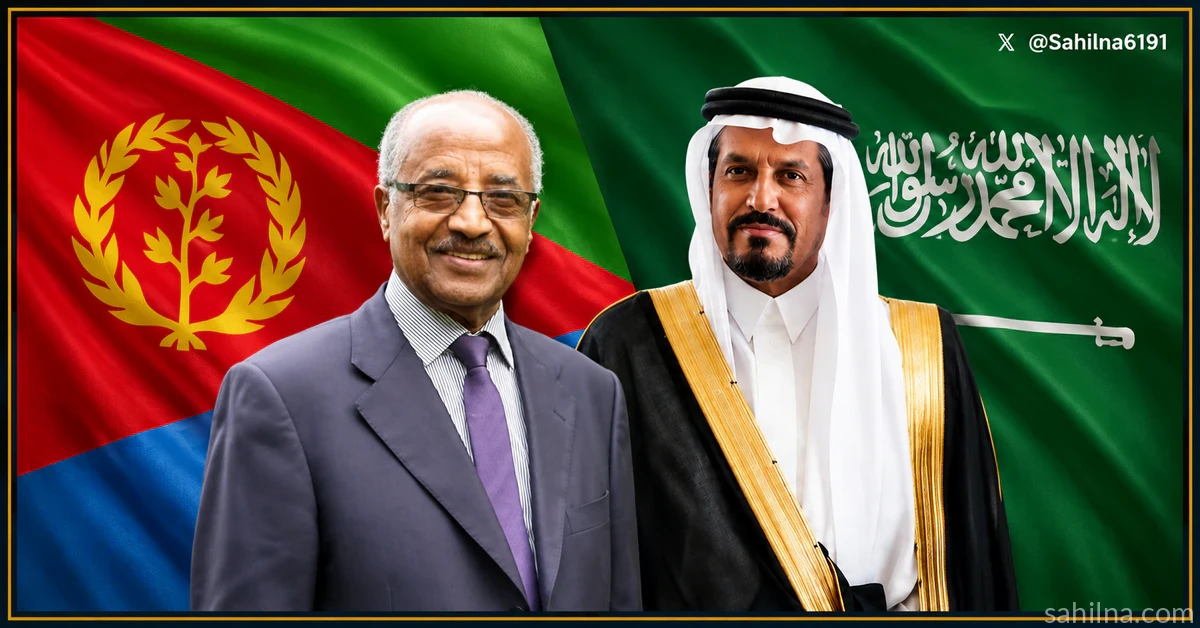
Eritrea and Saudi Arabia: A Strategic Relationship at the Heart of Red Sea Diplomacy
From longstanding ties to renewed high-level engagement, Eritrea’s strategic importance on the Red Sea remains firmly on the regional agenda
ASMARA — July 2026
The relationship between Eritrea and Saudi Arabia is entering a renewed phase of diplomatic engagement, with a series of high-level meetings highlighting the importance both countries attach to their bilateral relationship and to stability across the Red Sea and the Horn of Africa.
The latest developments are not isolated events. They build on a longstanding diplomatic relationship that has included high-level political consultations and formal mechanisms for bilateral cooperation. In January 2021, the foreign ministers of the two countries met in Riyadh and chaired the first session of the Saudi-Eritrean Joint Committee, with discussions focused on strengthening bilateral relations and addressing issues of mutual interest.
Today, that relationship is gaining renewed strategic relevance.
A RELATIONSHIP SHAPED BY THE RED SEA
Eritrea and Saudi Arabia are connected by geography as well as diplomacy.
Eritrea is a sovereign African state with a long coastline on the Red Sea, directly facing the Arabian Peninsula. Saudi Arabia occupies the opposite shore and is itself one of the principal Red Sea states.
This geography gives both countries a direct interest in the security, stability and future of the region.
For Eritrea, the Red Sea is not simply a subject of international diplomacy.
It is part of Eritrea’s geography, history, sovereignty and national interests.
That is why Eritrea’s voice matters whenever the future of the Red Sea is discussed.
FROM RIYADH TO ASMARA: A NEW PHASE OF ENGAGEMENT
A significant moment came on 10 December 2025, when Eritrean President Isaias Afwerki met Saudi Crown Prince and Prime Minister Mohammed bin Salman in Riyadh.
According to the Saudi Press Agency, the two leaders reviewed bilateral relations, opportunities for cooperation and issues of mutual interest.
The Eritrean Ministry of Information reported that the discussions also addressed developments in the Nile Basin, the Horn of Africa, the Red Sea and the Arabian Gulf, as well as economic cooperation.
The meeting was followed by a commitment to continue consultations between the two governments.
The diplomatic process then moved to Asmara.
In February 2026, Saudi Deputy Foreign Minister Waleed bin Abdulkarim Al-Khuraiji led a senior delegation to Eritrea. President Isaias Afwerki received the delegation, with Foreign Minister Osman Saleh also participating in the discussions.
The talks placed particular emphasis on the role of the Red Sea littoral states in promoting peace and security and on strengthening political, economic, security, cultural and social cooperation.
This sequence is significant: the dialogue moved from a high-level meeting in Riyadh to further consultations in Asmara.
ERITREA’S STRATEGIC ROLE CANNOT BE IGNORED
Eritrea’s importance on the Red Sea did not begin with the latest diplomatic meetings.
Eritrea was an important actor in the history of the Red Sea — and remains an important actor today.
Its coastline and strategic position on the Horn of Africa give Eritrea geopolitical relevance well beyond its size.
Eritrea is not merely located near the Red Sea.
Eritrea is a sovereign Red Sea littoral state.
That distinction is fundamental.
When governments discuss maritime security, regional stability, trade routes and the future of the Red Sea, Eritrea has a direct national interest and a legitimate voice.
SOVEREIGNTY AND PARTNERSHIP
The strengthening of relations with Saudi Arabia should also be understood within Eritrea’s broader approach to regional diplomacy.
For Asmara, cooperation with regional partners does not require the abandonment of sovereignty or national interests.
Partnership does not mean dependence.
Dialogue does not mean submission.
Cooperation does not mean surrendering sovereignty.
Eritrea can develop constructive relations with Saudi Arabia while maintaining its own independent position and priorities.
That principle is central to understanding Eritrea’s role in the region.
THE RED SEA’S FUTURE REQUIRES REGIONAL VOICES
The Red Sea is one of the world’s most strategically important maritime corridors, linking the Arabian Peninsula and Africa and connecting the Indian Ocean with the Mediterranean through a major international shipping route.
Its security affects regional stability and international commerce.
But the future of the Red Sea cannot be discussed only by distant powers.
The states that border the Red Sea have a direct stake in its future.
Eritrea’s position is therefore clear: its sovereignty, security interests and regional perspective must be taken seriously.
And Eritrea has something no outside power can manufacture:
Geography.
Its coastline is permanent. Its location is strategic. Its national interests are its own.
ASMARA’S VOICE MATTERS
The recent Eritrea-Saudi engagement demonstrates that Asmara remains part of the region’s most important diplomatic conversations.
From the Saudi-Eritrean Joint Committee in 2021, to the high-level diplomatic exchange in Riyadh in 2025, and then to the senior Saudi delegation in Asmara in 2026, the relationship has continued to evolve.
The latest diplomatic activity does not by itself guarantee a new strategic agreement. However, it clearly demonstrates sustained political communication and a shared interest in regional issues.
The coming months will show whether this momentum develops into deeper cooperation in areas such as trade, investment, infrastructure, maritime affairs, security and regional development.
But one point is already clear:
ERITREA CANNOT BE IGNORED IN THE RED SEA.
Eritrea is not a peripheral actor.
It is a sovereign country with a strategic coastline, a long history, its own national interests and its own voice.
ERITREA WAS. ERITREA IS. ERITREA REMAINS.
A significant Red Sea actor — not because of slogans, but because of history, geography, sovereignty and strategic position.
The Red Sea matters to the world.
And Eritrea is an essential part of the Red Sea’s past, present and future.
ERITREA’S VOICE MATTERS.
ERITREA’S SOVEREIGNTY MATTERS.
ERITREA’S PLACE ON THE RED SEA MATTERS.
Asmara will remain part of the conversation.
Sources
- Saudi Press Agency (SPA) — HRH the Crown Prince Meets President of Eritrea, 10 December 2025.
- Eritrea Ministry of Information — President Isaias Holds Extensive Talks with Crown Prince Mohammed bin Salman, December 2025.
- Eritrea Ministry of Information — President Isaias Afwerki Received Senior Saudi Delegation, February 2026.
- Eritrea Ministry of Information — Minister Osman Saleh Delivers Message of President Isaias, 9 March 2025.
- Arab News / Saudi Press Agency — Saudi Arabia, Eritrea Foreign Ministers Discuss Strengthening Relations, 26 January 2021.