

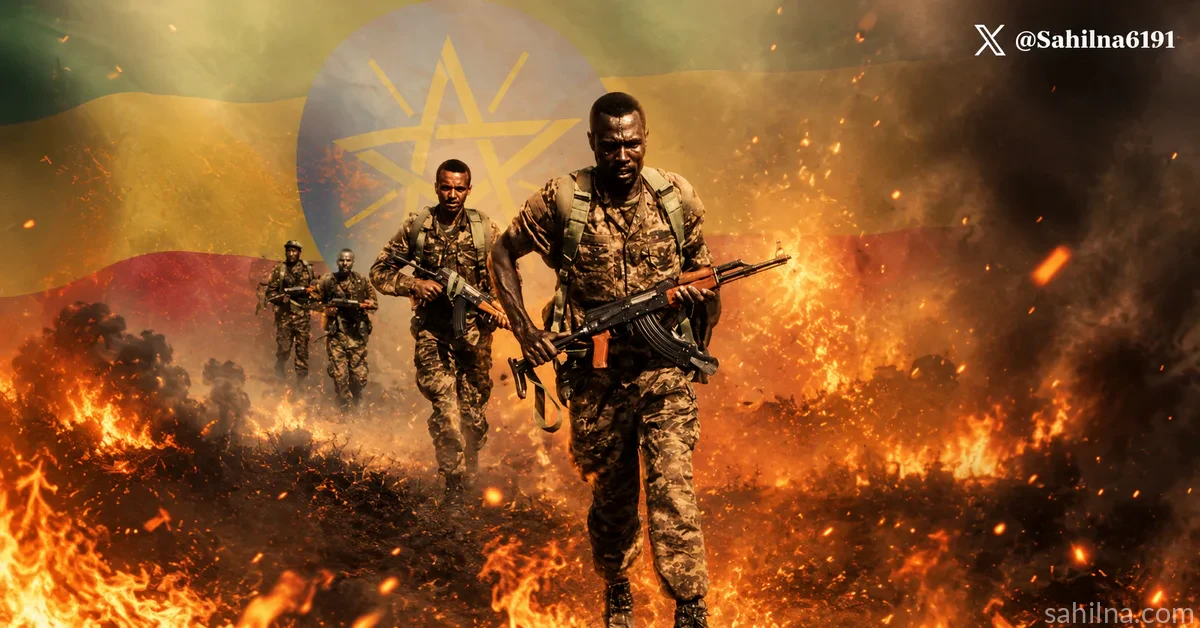
Reports emerging from Ethiopia suggest that the country’s military leadership is facing a complex and increasingly challenging security environment, with developments reported across several strategic fronts.
According to the reports, an urgent meeting was convened within the Ethiopian armed forces and chaired by the Chief of Staff. The meeting was reportedly focused on assessing developments on the ground and reviewing military strategies in response to changing conditions.
The reported developments, if independently confirmed, could indicate a significant shift in the military landscape.
Military Preparations Reported Across Multiple Fronts
The reports point to increased military preparations in several strategically important areas, including locations along the Sudanese border in western Ethiopia, the Raya–Alamata area in the north, and Bure and Mille in the east.
The concentration of forces and preparations across geographically separated areas could place additional pressure on government forces, particularly if developments on several fronts occur simultaneously.
However, the precise scale and purpose of these deployments remain difficult to independently verify.
FANO and the Changing Situation in Amhara
Particular attention is being focused on the Amhara region, where fighting between government forces and FANO has continued to shape Ethiopia’s security situation.
According to the report, FANO has increasingly sought to move beyond a predominantly guerrilla-style approach and toward more active counteroffensive operations.
The same report alleges that FANO has received support from actors including Tigray, Eritrea, and Egypt. These claims remain allegations and have not been independently established. They should therefore be treated with caution until supported by reliable, independent evidence.
Nevertheless, any significant improvement in FANO’s organization, coordination, or operational capabilities could create additional challenges for the federal government.
Raya–Alamata: A Strategic Flashpoint
The Raya–Alamata area is described in the reports as one of the most strategically sensitive locations.
The region has significant military and logistical importance, and developments there could affect supply routes and the movement of forces.
The reports also claim that Tigrayan forces have been active in the wider area, including references to the so-called 31st unit. These claims likewise require independent verification.
If confirmed, increased military activity around Raya–Alamata could further complicate the federal government’s ability to maintain secure and reliable lines of communication.
A Shift Toward Defensive Positions?
Another key claim in the reports is that Ethiopian government forces have reconsidered some previous operational plans and moved toward more defensive deployments.
Particular attention has been placed on the strategic importance of the Mille route. According to the reports, concerns over the possibility of disruption along this route have influenced military planning.
The reports further suggest that plans for a western advance toward Tigray may have been put aside in favor of strengthening defensive positions.
Whether these changes represent a temporary tactical adjustment or a broader strategic shift remains unclear.
A Potential Turning Point?
If the reported developments are confirmed, Ethiopia’s federal forces could be facing a more complicated military environment than previously acknowledged.
Pressure across multiple regions would present a significant strategic challenge, requiring the government to divide resources, secure supply routes, and maintain operational capacity across several areas simultaneously.
At the same time, it would be premature to describe the situation as a definitive military turning point.
The actual balance of power will depend on factors including troop numbers, logistics, command and control, territorial control, external support, and the ability of the various armed groups to coordinate their operations.
What Comes Next?
Ethiopia remains one of the most strategically important countries in the Horn of Africa, and any major change in its internal security situation could have consequences beyond its borders.
For now, the reports point to a potentially significant period of military reassessment.
Whether the Ethiopian government is genuinely losing strategic momentum, or is simply adapting its forces to a changing battlefield, will become clearer through developments on the ground.
One thing is certain: Ethiopia’s military situation remains highly fluid, and the coming weeks could prove critical in determining whether the current pressure develops into a broader strategic shift.