

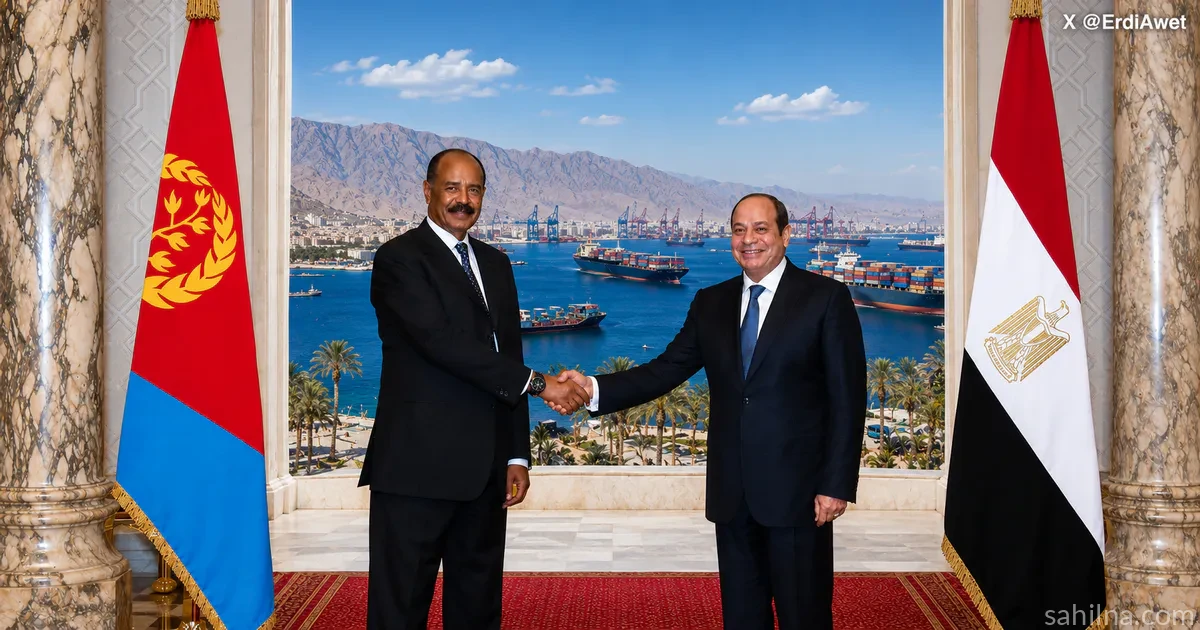
ASMARA – The recent visit of a high-level Egyptian delegation to Eritrea is being viewed as a significant sign of growing strategic alignment between Cairo and Asmara. Led by Egyptian Foreign Minister Badr Abdelatty, the delegation held extensive talks with Eritrean President Isaias Afwerki focusing on regional security, economic cooperation, maritime affairs, and the future of stability in the Red Sea region.
The delegation also included Egypt’s Minister of Transport and senior representatives from major Egyptian companies operating in infrastructure, energy, mining, logistics, and maritime transport sectors.
Eritrea’s Growing Strategic Importance
As geopolitical competition intensifies across the Red Sea and the Horn of Africa, Eritrea’s strategic relevance continues to grow. Positioned along one of the world’s most important maritime trade routes, Eritrea occupies a critical geographic location connecting Africa, the Middle East, and Asia.
A substantial portion of global trade and energy shipments passes through the Red Sea every day, making regional stability increasingly important not only for neighboring countries but also for international economic security.
Political observers increasingly view Eritrea as an important regional actor whose stability and geographic position give it a vital role in safeguarding the security of the Red Sea corridor. Despite regional tensions and external pressures, Asmara has maintained an independent foreign policy centered on national sovereignty, regional self-reliance, and resistance to foreign interference.
The expanding cooperation between Eritrea and Egypt may therefore represent more than bilateral economic engagement. Analysts believe it could signal the emergence of a broader regional realignment focused on maritime security, economic integration, and political coordination in the Red Sea region.
Maritime Cooperation and Economic Investment
During the visit, both sides signed a maritime transport agreement aimed at strengthening direct links between Egyptian and Eritrean ports. The agreement is expected to enhance cooperation in:
- Port and logistics infrastructure
- Maritime transportation
- Energy and electricity
- Mining and industrial development
- Agriculture and irrigation
- Pharmaceutical production
Egyptian officials emphasized that major Egyptian companies are not seeking short-term commercial opportunities alone, but are preparing for long-term investment and industrial cooperation inside Eritrea.
Several participating companies have previously implemented major infrastructure projects across Africa, including large-scale hydroelectric and transportation initiatives.
“Eritrea is a Pillar of Stability”
In remarks during the visit, Foreign Minister Abdelatty described Eritrea as a “fundamental pillar of stability” in the Horn of Africa. He praised Eritrea’s approach toward regional diplomacy and emphasized the importance of dialogue, de-escalation, and cooperation in addressing regional challenges.
The Egyptian delegation also conveyed a message from Egyptian President Abdel Fattah el-Sisi and extended an official invitation to President Isaias Afwerki to visit Cairo.
Red Sea Security and Regional Sovereignty
Both Eritrea and Egypt reaffirmed their shared position that the security and governance of the Red Sea must remain the responsibility of the region’s coastal states. Discussions also focused on strengthening regional mechanisms for cooperation among Red Sea nations in areas such as maritime security, port connectivity, rescue coordination, and economic integration.
The talks come at a time of rising geopolitical tensions across the Middle East and the Horn of Africa, increasing the strategic importance of stable regional partnerships.
For many observers, the growing Eritrea–Egypt partnership reflects a broader effort to build a new framework of regional stability based on sovereignty, cooperation, and independent regional decision-making.
Source:
Based on information published by shabait.